As you can tell, I’m a retro video game enthusiast whose favorite developer is Namco. I started an Instagram page in November 2024 dedicated to the history of Namco, ranging from its founding in 1955 to its dissolution into the Japanese toy company Bandai in 2006. I wanted to take my Namco History web presence beyond Instagram, so I eventually created Facebook and Bluesky pages, a YouTube channel, and a website.
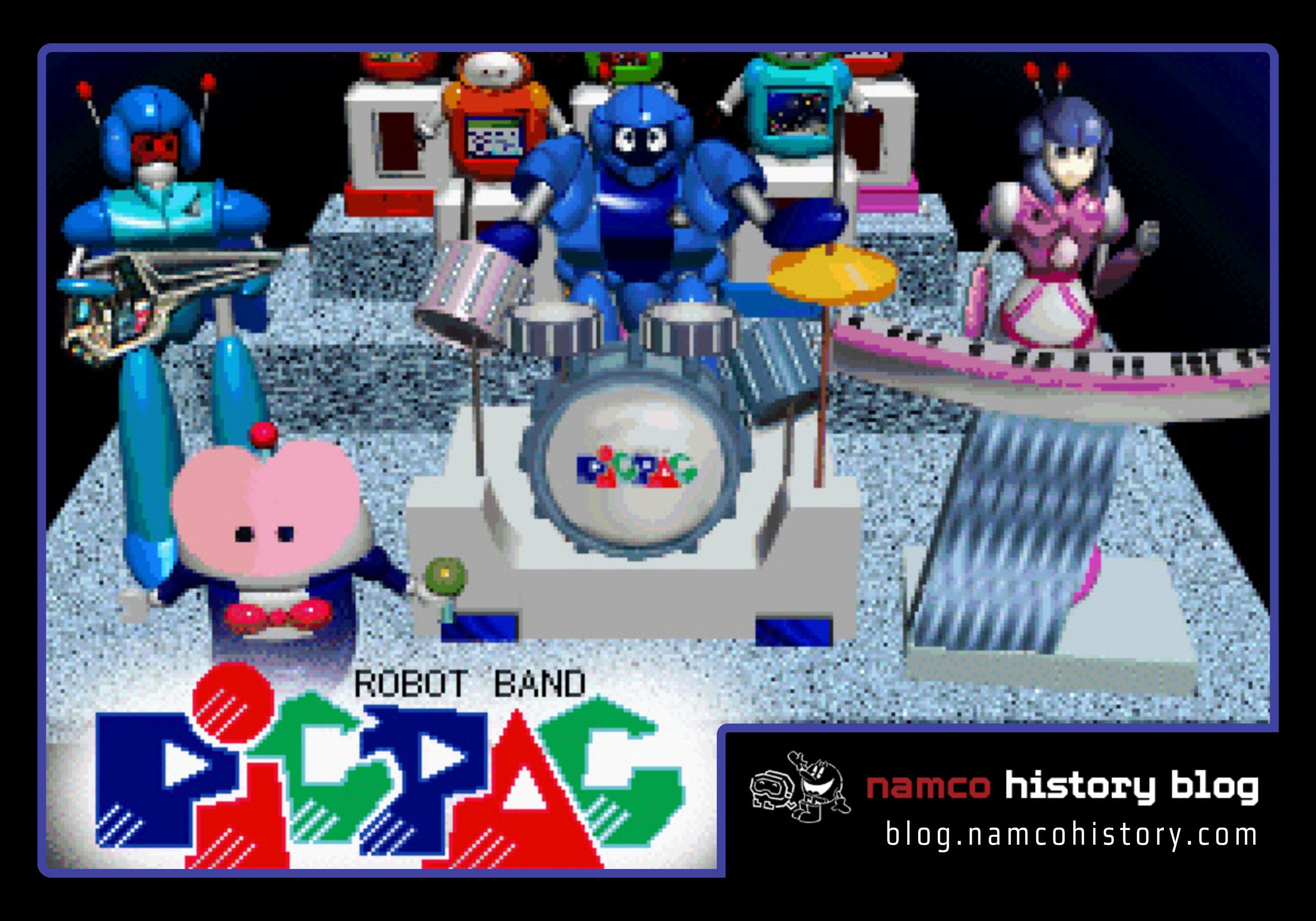
I recently created this blog for topics going more in-depth than a social media post. I noticed that a clip I posted of Namco’s animatronic Robot Band PiCPAC performing for a Japanese news segment blew up on Instagram. With PiCPAC being a niche part of Namco’s history, I was not expecting the clip to gain that much attention. I found out about the huge animatronics community, especially those passionate about the animatronics from Chuck E. Cheese and ShowBiz Pizza Place.
The clip I posted throughout the Namco Historian social account was sourced from a YouTube upload by VideoDojo, who did extensive research on Namco’s lost robot band.
The news segment originally aired on Tokyo Broadcast System’s Teleport 6 News on November 16, 1984. The news segment begins with a reporter interviewing Maji Mentarō, the robot manager and emcee of PiCPAC. After the conversation, the curtains rise and the band performs their intro song PiCPAC’s Theme.
PiCPAC’s Theme and another song, Robot March, can be heard in a virtual concert in Namco Museum Vol. 4, part of a series of PlayStation games celebrating Namco’s history. When the game was released outside of Japan for the international market, the songs with the Japanese lyrics were cut. Those with the international copy of Vol. 4 were treated to only the instrumental versions of PiCPAC’s two songs. VideoDojo uploaded the Namco Museum concert if you want to listen to the full versions (both lyrical and instrumental) of the songs.
The news segment was originally found in a collection of VHS recordings from former Namco employee Norio Nakagata, the music supervisor for PiCPAC. Nakagata was the composer for various Namco arcade games, including Motos (1985), Thunder Ceptor (1986), Baraduke (1986), Genpei Tōma Den (1986), Baraduke II (1988), Bravoman (1988), and Mirai Ninja (1988).

Shigeki Toyama was another mastermind behind PiCPAC. Toyama was originally hired in Namco’s robotics division. His earliest works of his when working at Namco were two robots, Nyamco the cat and Mappy the mouse, that would navigate mazes in micromouse competitions. The two characters would later star in Namco’s arcade games Mappy (1983) and Hopping Mappy (1986). Toyama also made design contributions to Xevious (1982). After Namco’s robot division was dissolved, Toyama was involved with the mechanical design of Namco arcade games, including the light-gun games Lucky & Wild (1993) and Point Blank (1994), and Prop Cycle (1996), a Ghibli-inspired flight simulator controlled with an attached cycle. Toyama was the designer of Galaxian3: Project Dragoon, a VR experience based on Namco’s classic arcade game Galaxian (1979). Galaxian3 was showcased at Expo ’90 Osaka and was later an attraction at Namco’s Wonder Eggs amusement park in Japan.


PiCPAC was one of the most ambitious electromechanical projects of Namco. The animatronic band consisted of three robot members, all introduced in the song PiCPAC’s Theme: Maria Socket, vocalist and keyboardist; Strobo Gonzales, drummer; and Digital Tome III, guitarist. The band would perform several times at various venues in Japan throughout the ’80s.


After Namco no longer had any use for PiCPAC, the animatronics were in the possession of various outside parties. The band’s last known appearance was at a department store in Taiwan in the early ’90s. (A home video recording of the band performing at a Taiwanese store was uploaded to YouTube.)
The detailed history of Robot Band PiCPAC is explored in a documentary by VideoDojo uploaded on YouTube. VideoDojo later made a follow-up video about how the TBS news segment featuring PiCPAC was found and uploaded online for the world to see.
The more obscure parts of Namco’s history are my favorite things to post on the Namco Historian social accounts. Namco may be best known for its arcade games, but my goal is to bring awareness to the variety of the company’s 50-year history. PiCPAC is definitely a fascinating footnote in Namco history. Playing Namco Museum Vol. 3 as a kid, I noticed a PiCPAC poster inside the virtual museum, unaware that the band once existed.
Once making an impact, PiCPAC’s whereabouts are a mystery that is sadly unsolved.
If you like this post, please check out my other Namco content. Visit the Namco Historian at namcohistory.com and stay updated on Instagram, Facebook, Bluesky, and YouTube. Special thanks to VideoDojo for their extensive research on Robot Band PiCPAC and for bringing the lost animatronic band back into the spotlight. Please support VideoDojo by subscribing to their YouTube channel.